
It's Time to Pause for Menopause
Written by Nicole Levesque, QWHA Academic Director
For premenopausal females, menopause can feel like an ‘uncertain future concept’. If you think about how many times you’ve spoken about menopause within your peer groups and families, I’m sure it doesn’t happen too often. This is partly because of the stigma surrounding menopause.
As we know, our society has developed quite a beauty standard for women. Youthfulness is admired while aging is frowned upon. There’s a feeling of disappointment that is associated with menopause because women are labelled as “past their prime” once they have reached this time point.
It’s unfortunate that this aspect of female aging isn’t normalized, but it doesn’t have to be like this! By gaining a physiological understanding of menopause and its affiliated symptoms, we can begin to view this stage as a new beginning. Premenopausal women can become familiar with something that might feel very unfamiliar, and women experiencing menopause can still feel shamelessly youthful (despite some of the frustrating symptoms that menopause can invoke).
So, let’s take a pause to look at the various stages of menopause (yes, it has multiple stages that spread throughout aging!).
WHAT IS MENOPAUSE?
Menopause is the permanent ending of a female’s reproductive potential due to the loss of ovarian follicles and a decline in estrogen (1). In simpler terms, the supply of egg follicles that females are born with are no longer viable for maturation, and the ovaries reduce estrogen production. The ending of ovarian follicular activity leads to the activation of feedback mechanisms between the ovary, hypothalamus, and pituitary gland, altering reproductive hormone levels (2). This ultimately leads to amenorrhea (the absence of menstruation).
SYMPTOMS OF MENOPAUSE
The symptoms of menopause can be divided into three categories: psychological and cognitive, vasomotor, and urogenital (3):
Psychological and cognitive — these symptoms can influence emotional and cognitive functioning
Brain fog
Word-finding difficulties
Increasing forgetfulness
Changes in mood and irritability
Vasomotor — these symptoms are inclusive of bodily temperature disregulation caused by hormonal changes (4)
Hot flushes
Night sweats
Can influence sleep quality
Urogenital — these symptoms are collectively known as the Genitourinary Syndrome of Menopause (GSM), caused primarily by a decrease in estrogen
Vaginal dryness or irritation
Bladder and urination difficulties
Vulvovaginal atrophy
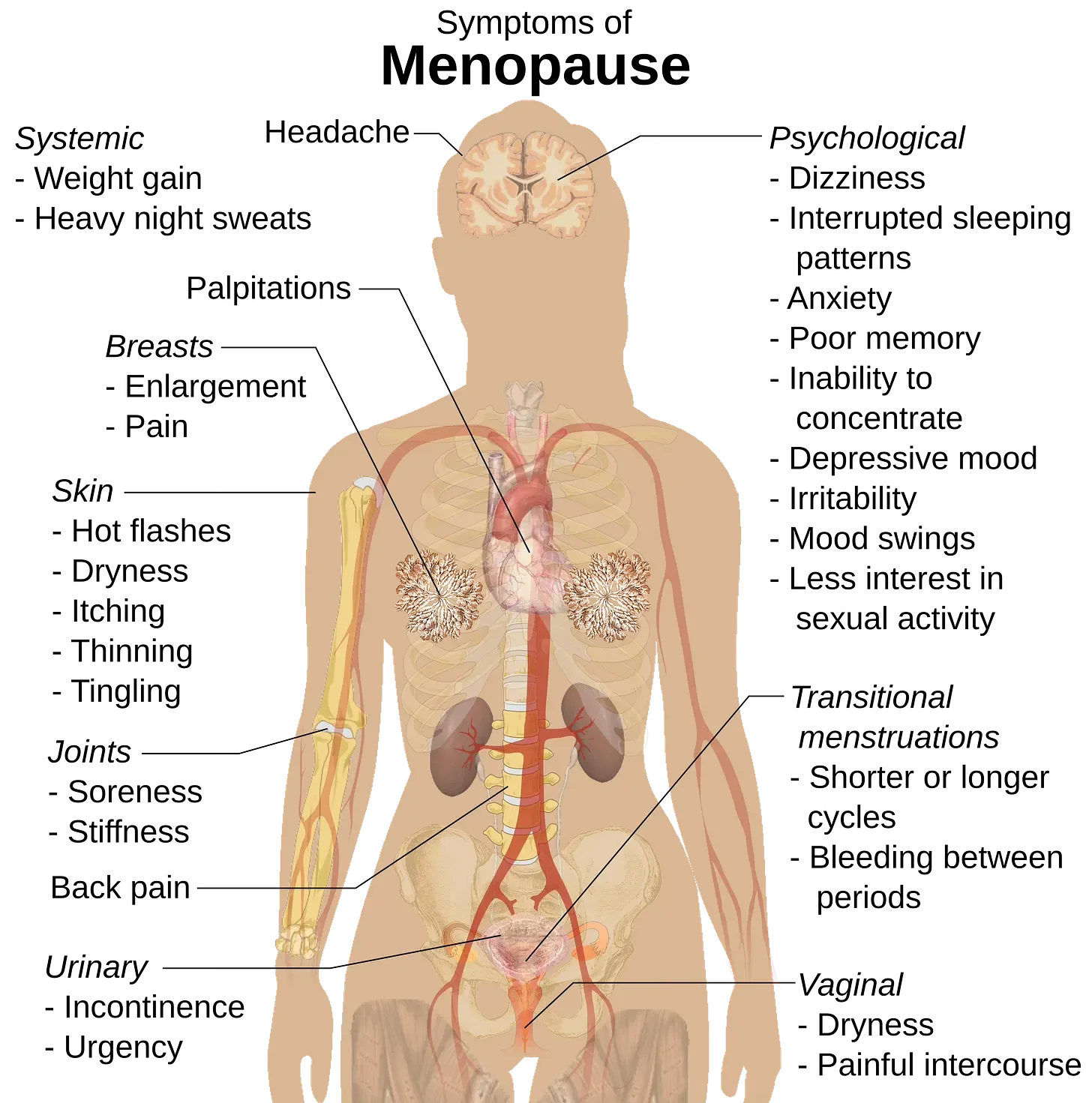
Image Credit: Mikael Häggström, 2015
STAGES OF MENOPAUSE
Menopause includes several stages, ranging from the late reproductive years to postmenopause. The transition into menopause, including the perimenopausal stage of irregular menstrual cycles, occurs over a period of several years (5). The gold standard description of reproductive aging is outlined by The Stages of Reproductive Aging Workshop (STRAW+10) (6). We’ve summarized the stages below:
The Late Reproductive Stage — Menopause begins when women are in their late reproductive years. The menstrual cycle is still occurring, but irregularities are observed.
Represents the beginning of reduced fertility
Subtle changes in menstrual cycle
Menopausal Transition — The menopausal transition is separated into two categories: early menopausal transition and late menopausal transition.
Early Menopausal Transition
Identifies the beginning of perimenopause (time around menopause; begins at early menopausal transition and ends 12 months after the final menstrual period)
Menstrual cycle length becomes more variable
A persistent ~ 7 day variation in cycle length
Increased follicle stimulating hormone (FSH) in early follicular phase
Late Menopausal Transition
Amenorrhea for 60 days or longer
Extreme fluctuations in hormonal levels
FSH increases significantly
Resistance develops to hormone increases
Increased inhibition of ovulation
Symptoms occur
Duration: 1 – 3 years
Postmenopause — This stage marks the ending of perimenopause and can be separated into early and late stages. Many symptoms experienced during the menopausal stage can cease at this point. This time is defined by a missing menstrual cycle for over 12 months.
Early Postmenopause
Identifies the end of perimenopause
Marks the stabilization of high FSH and low estradiol
Symptoms still occur
Duration: 5 – 8 years
Late Postmenopause
Somatic aging
Symptoms of late postmenopause:
Vaginal dryness
Urogenital atrophy
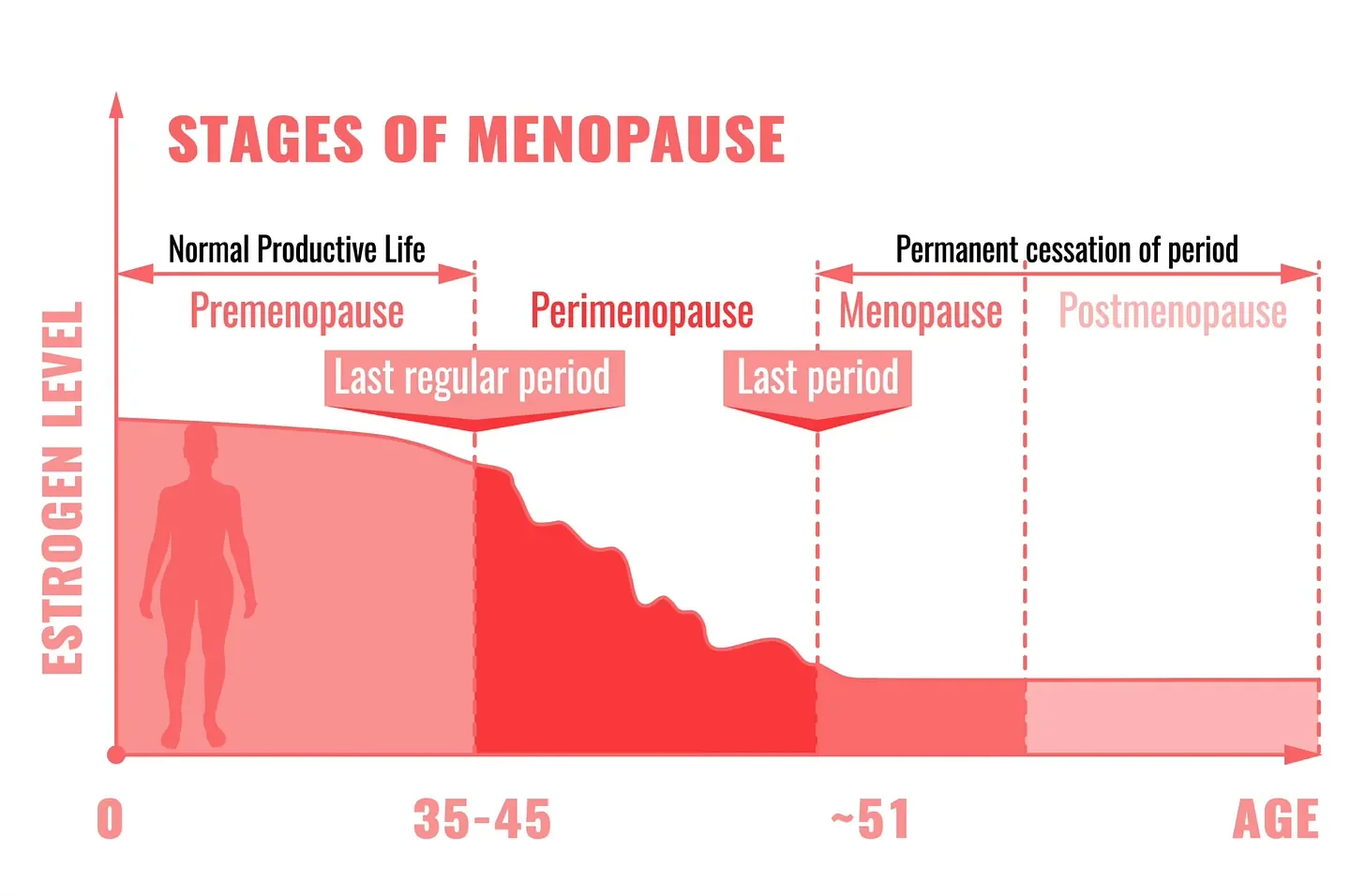
Image Credit: Shutterstock, 2018
THE EFFECTS OF DECREASED ESTROGEN
Estrogen is a vital hormone. Not only is it important for reproductive health, but it has many other roles in bodily systems, particularly the skeletal system.
Bone cells are constantly breaking down and renewing themselves in our body. This process is called bone remodelling. Estrogen influences bone remodelling, and when estrogen declines, bone loss occurs faster than bone regeneration leading to decreased bone density (7). This process begins in perimenopause and is common in postmenopausal women, putting them at greater risk of developing osteoporosis (7).
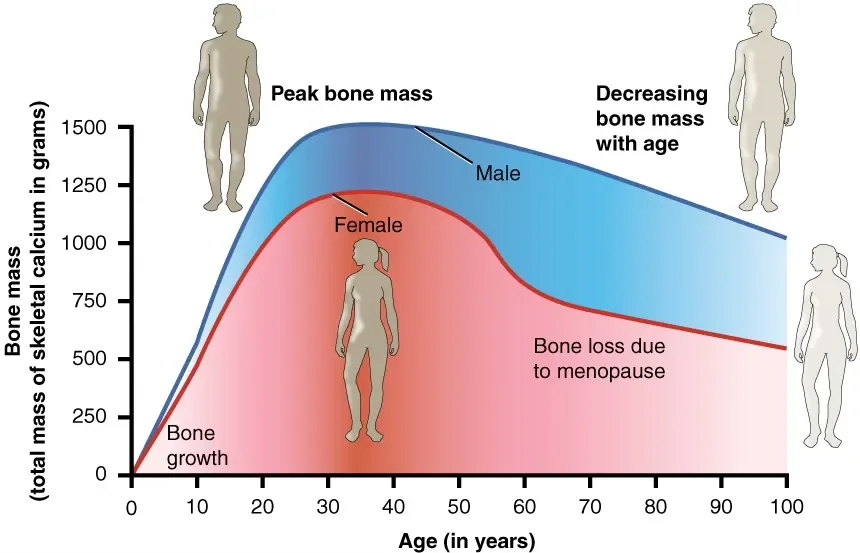
Image Credit: OpenStax College, 2013
IN CONCLUSION….
After reading about the symptoms of menopause, it might be easy to dread this time. However rather than dreading menopause, premenopausal women can prepare for it! The more informed women are about this stage of life, the more inclined they will be to experience it.
By talking about menopause, we can reduce the stigma about it. We should be able to comfortably discuss this normal period of a woman’s life, so we can support those experiencing menopause-related challenges.
References
1. Society CM. Advancing Mature Women’s Health. Canadian Menopause Society. Updated 2026. 2026.
2. Talaulikar V. Menopause transition: Physiology and symptoms. Best Practice & Research Clinical Obstetrics & Gynaecology. 2022/05/01/ 2022;81:3–7. doi:https://doi.org/10.1016/j.bpobgyn.2022.03.003
3. Gatenby C, Simpson P. Menopause: Physiology, definitions, and symptoms. Best Practice & Research Clinical Endocrinology & Metabolism. 2024/01/01/ 2024;38(1):101855. doi:https://doi.org/10.1016/j.beem.2023.101855
4. Deecher DC, Dorries K. Understanding the pathophysiology of vasomotor symptoms (hot flushes and night sweats) that occur in perimenopause, menopause, and postmenopause life stages. Arch Womens Ment Health. 2007;10(6):247–57. doi:10.1007/s00737-007-0209-5
5. Li S, Lanuza D, Gulanick M, Penckofer S, Holm K. Perimenopause: The transition into menopause. Health Care for Women International. 1996/07/01 1996;17(4):293–306. doi:10.1080/07399339609516246
6. Harlow SD, Gass M, Hall JE, et al. Executive summary of the Stages of Reproductive Aging Workshop + 10: addressing the unfinished agenda of staging reproductive aging. Menopause. Apr 2012;19(4):387–95. doi:10.1097/gme.0b013e31824d8f40
7. Canada O. Menopause & Bone Health. Osteoporosis Canada. 2026. https://osteoporosis.ca/menopause-and-bone-health/
